Lineage & Instruction
Huronia Goju-Ryu is rooted in traditional Okinawan Goju-Ryu and operates within the Kenshikai system. Instruction follows established principles of lineage, technical accountability, and personal responsibility—where authority is derived from training, not self-appointment.
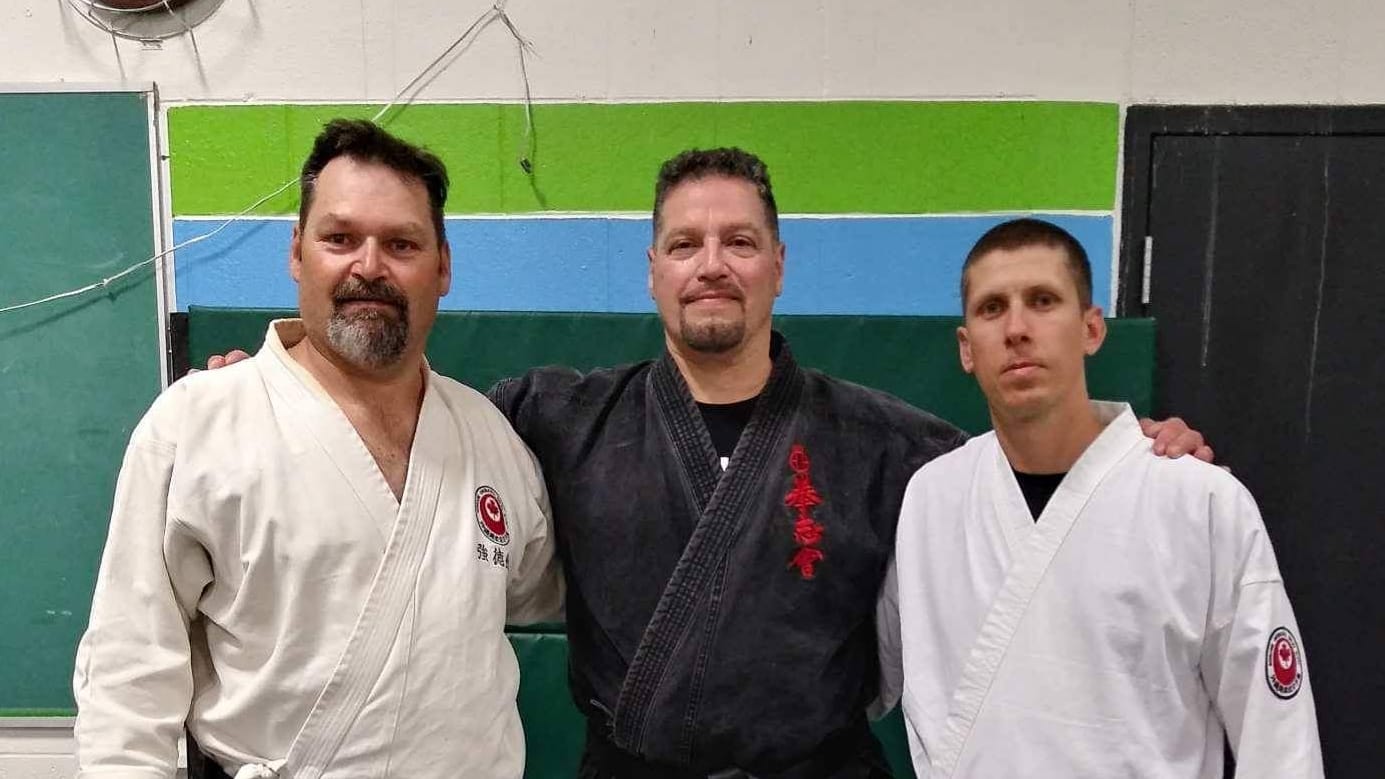
Ryan Stacey’s formal Goju-Ryu development took place under the direct mentorship of Renshi Peter St. Onge, founder of Simcoe Goju-Ryu. Training emphasized structure, breath control, biomechanics, and applied interpretation of kata. Advancement was deliberate and uncompromising, grounded in understanding rather than time or prior rank.
Following Renshi St. Onge’s passing, Ryan continued his progression within Kenshikai under the guidance of Hanshi Luis Morales, maintaining continuity of instruction and adherence to recognized Goju-Ryu standards. Ongoing development is conducted through formal evaluation, curriculum alignment, and continued personal training.
Huronia Goju-Ryu exists to preserve this lineage while carrying forward the responsibility entrusted to its instructor: to teach the art as it was received—honestly, methodically, and without dilution.
Instruction and oversight continue within the Canadian branch of North American Kenshikai, ensuring accountability to living instructors and recognized standards.
Martial Arts Background
Ryan Stacey’s martial arts training began in 2001 at Huronia Mixed Martial Arts Academy (HMMAA) in Midland, Ontario. The academy offered a broad, hybrid curriculum that included Kenpo Karate, Shotokan, Jujitsu, and weapons training, allowing students to develop across multiple disciplines under different instructors. This environment emphasized adaptability, pressure testing, and functional movement rather than stylistic isolation.
During this period, Ryan progressed to Brown Belt and was first introduced to Goju-Ryu principles under Sensei Bob Houston, an Ontario Provincial Police officer whose instruction emphasized practical application and control-based self-defense. These early experiences established a foundation rooted in structure and realism, while also revealing that martial arts extended far beyond technique and rank.
From 2005 to 2009, Ryan continued training at Mayers Martial Arts, where the curriculum remained primarily Shotokan- and Kempo-based. While Goju-Ryu elements were present, the system lacked the depth and immersion he was seeking. These years reinforced a growing awareness that a cohesive, lineage-based system was essential for long-term development.
Alongside this training, Ryan has maintained continuous study in Jujitsu since 2001, emphasizing efficient transition between standing and ground engagement. Weapons exposure has included Okinawan Kobudo (Bo, Sai, and Nunchaku) under Sensei Peter St. Onge, as well as Kali stick and staff training under Sensei Bob Houston. These elements were never pursued in isolation, but as supporting disciplines within a broader Goju-Ryu framework.
Searching for the Right Path (2008–2015)
Between 2009 and 2011, Ryan attended Fleming College in the Police Foundations program. Training during this period focused on defensive tactics, controlled holds, and scenario-based application. Martial skills were no longer theoretical—they were tested in practical, high-stress contexts alongside peers preparing for law enforcement careers.
Following graduation, Ryan returned home and resumed training under Sensei Shawn Buttineau at Shawn’s MMA & Self-Defense, refining both striking and grappling skills while continuing to emphasize realism and adaptability. Instruction during this period was supplemented by community seminars, peer-based sparring, and applied self-defense training.
In 2016, Ryan enlisted in the Canadian Armed Forces as an Infantryman. Military service introduced formal hand-to-hand combat instruction and close-quarters battle (CQB) training, reinforcing principles of efficiency, structure, and decision-making under pressure. This experience further shaped his understanding that martial arts must function reliably in unpredictable, real-world conditions.
These years of applied training created a broad, practical foundation—one that would later be disciplined and refined through traditional Goju-Ryu.
A Return to White Belt: Training Under Sensei Peter St. Onge
Ryan’s search for structured traditional training led him to Coldwater, Ontario, where he enrolled in Kang-Jou Kempo Karate under Hanshi Gord Farmer. During training, Renshi Peter St. Onge observed Ryan’s movement and recognized an underlying Goju-Ryu foundation within his technique. Although Renshi was his formal title within the system, St. Onge served in the direct role of instructor and mentor, and was therefore addressed—as he was by his students—as Sensei.
He pulled Ryan aside and invited him to train privately in Goju-Ryu.
At the time, Ryan held a Brown Belt from previous systems. Sensei St. Onge was clear in his assessment:
“You are not a Brown Belt in Goju. In my system, you are a Green Belt.”
Ryan accepted the reset without hesitation. Rank was irrelevant—understanding was everything.
Training under Sensei St. Onge emphasized biomechanics, breathing, internal power generation, and applied kata interpretation. Advancement was intentionally delayed to ensure comprehension, patience, and humility. Belts were treated as markers of responsibility, not achievement.
The Final Lesson and the Responsibility to Carry It
On February 4, 2023, Sensei St. Onge awarded Ryan his 3rd Kyu (Brown Belt) in Goju-Ryu. The rank carried meaning not because it was regained, but because it was earned correctly.
In their final class together, Sensei St. Onge awarded Ryan his last stripes, making him 1st Kyu, and told him the words he had waited years to hear:
“You’re ready for your Shodan test.”
Later that same night—January 13, 2025—Renshi St. Onge passed away.
The loss was immediate and profound. In the days that followed, Ryan remained in close contact with Sensei St. Onge’s family and students, while receiving guidance and support from senior Goju-Ryu practitioners. Among them was Hanshi Luis Morales, who recognized the responsibility now placed before him.
Faced with uncertainty, Ryan gathered the students of Simcoe Goju-Ryu to ask the question that mattered most: what happens now?
The Pledge: A Promise Made Public
On February 15, 2025, Sensei St. Onge’s Celebration of Life was held. Ryan was asked to read words prepared by Sensei Dean Goddard, who was unable to attend due to weather conditions.
After reading the prepared remarks, Ryan spoke from the heart:
“I was Sensei St. Onge’s last senior student. He pushed me, challenged me, and taught me beyond the art itself. I stand here today not just as someone who trained under him, but as someone who was shaped by him.
I will not let his teachings fade.
I will find a way to continue his legacy.
I will do whatever it takes to ensure that what he built does not end here.”
In that moment, a promise was made—one accepted by the family and the students alike.
Kenshikai, Family, and the Path to Shodan
Following the passing of Sensei Peter St. Onge, Ryan remained connected to the broader Goju-Ryu community through the Kenshikai family. Hanshi Luis Morales reached out directly, offering guidance, continuity, and support during a period of uncertainty. Although Peter had never formalized his own association, his training lineage, standards, and instruction were deeply aligned with Kenshikai, and Ryan had trained under that influence throughout his time with him.
Hanshi Morales welcomed Ryan into the Kenshikai family and made it clear that he would be supported and guided forward. Through Hanshi, Ryan was introduced to Sensei Stacy Kremer and Sensei Michael Den Tandt, both Shibu instructors within the Kenshikai system. Each offered time, perspective, and instruction, answering questions, sharing experience, and reinforcing that Kenshikai was not simply an organization, but a family rooted in shared responsibility.
Ryan was invited to attend a Kenshikai seminar in Kingston, Ontario, hosted at Sensei Kremer’s dojo. Despite the long drive from Penetanguishene, he made the trip with his wife, marking the first time Hanshi Morales formally observed him as a direct student within the system. Training that weekend was demanding and thorough, followed by continued instruction the next day. It was during this seminar that Hanshi began assessing Ryan more closely, both technically and personally.
In the months that followed, Hanshi Morales provided extensive curriculum materials, literature, and guidance documents outlining Kenshikai standards, structure, and expectations. Through this process, Ryan gained deeper insight into what had originated with Sensei St. Onge and what had been shaped under Hanshi’s mentorship, recognizing the continuity between the two while also understanding the responsibility of entering a larger, more formal system.
Training continued throughout the year through consistent video submissions, feedback, and direct instruction from Hanshi Morales, alongside ongoing dialogue with Sensei Kremer and Sensei Den Tandt. Together, these instructors provided perspective from different stages of the Kenshikai path, reinforcing both technical accuracy and cultural responsibility.
Hanshi later returned to Canada for another seminar at Sensei Den Tandt’s dojo in Owen Sound, where Ryan had hoped to be evaluated for Shodan. Tragically, the night before the seminar, Ryan’s niece passed away suddenly at the age of twenty-one. Unable to attend, he watched as others progressed while he remained sidelined—not by lack of preparation, but by circumstance.
Rather than withdrawing, Ryan addressed the situation directly. He asked Hanshi to continue the process remotely, requesting to be evaluated fully and without exception. Hanshi agreed.
On November 25, 2025, after hours of detailed review, discussion, and technical evaluation conducted virtually, Hanshi Luis Morales formally recognized Ryan Stacey as Shodan in Kenshikai Goju-Ryu. The certification was issued through Kenshikai, bearing formal recognition from Okinawa, and signed by Sensei Hokama, Head of Kenshikai—affirming legitimacy, lineage, and accountability at the highest level of the system.
The recognition affirmed not only technical competence, but readiness to carry responsibility within the Kenshikai family.
Huronia Goju-Ryu: A Legacy Carried Forward
With Shodan earned and responsibility formally acknowledged, Hanshi Morales granted permission for Ryan to establish a Kenshikai Shibu in honor of Sensei Peter St. Onge. This was not a continuation of Simcoe Goju-Ryu in name, but a continuation of its spirit, discipline, and standards through a new chapter.
Huronia Goju-Ryu was founded as that chapter.
The name reflects both place and purpose—honoring the region where Ryan’s martial journey began, while anchoring the school within the Kenshikai system, one of the most direct and closely guarded Goju-Ryu lineages. The teachings carried forward are not diluted, modernized, or commercialized, but preserved through structured curriculum, technical oversight, and continued personal development.
Alongside Kenshikai, Ryan continues to draw wisdom and perspective from Sensei Dean Goddard, a close friend of Sensei St. Onge and a respected Goju practitioner in his own right. Though not affiliated with Kenshikai, Dean’s guidance, experience, and broader martial knowledge remain an important influence, contributing to the development of Ongeikan—an expression of applied Goju-Ryu shaped by lived experience rather than theory alone.
Huronia Goju-Ryu was publicly announced on December 13, 2025—Sensei St. Onge’s birthday—along with its crest. The timing was deliberate. Not as a memorial, but as a statement of continuation.
Huronia Goju-Ryu stands as the newest Shibu within the Canadian branch of North American Kenshikai—rooted in one of the oldest and most direct Goju-Ryu lines, guided by living instructors, and grounded in responsibility rather than rank.
The training continues.
The lineage remains intact.
The legacy moves forward.